This article contains affiliate links. If you purchase through these links, we may earn a commission at no extra cost to you. Full disclosure
Why Compound Lifts Are Non-Negotiable After 35
If you're over 35 and still chasing isolation exercises, you're making your life harder than it needs to be. Your time in the gym is precious—limited by work, family, and recovery capacity—so you need maximum return on every set.
Compound lifts (movements that engage multiple muscle groups across multiple joints) are the foundation of any effective strength program for aging athletes. They build functional strength, preserve muscle mass, boost testosterone, and deliver results in half the time of split routines.
But here's the thing: proper form matters more after 35 than it ever did. Your joints aren't as forgiving, your recovery is slower, and an injury sets you back months, not weeks. That's why this guide focuses on mastering the five lifts that generate the most bang-for-buck: the deadlift, squat, bench press, overhead press, and barbell row.
Master these movements, apply progressive overload systematically, and you'll build serious muscle, strength, and resilience at any age.
The Deadlift: The King of All Exercises
What It Works
Primary muscles: Lower back, glutes, hamstrings, lats. Secondary: Traps, grip strength, core.
The deadlift targets more muscle mass in a single movement than any other lift. You're recruiting your entire posterior chain—the muscle groups that extend your hips and back, which are critical for posture, injury prevention, and functional strength.
How to Deadlift with Perfect Form
The Setup: Feet hip-width apart, bar over mid-foot (when you look down, the bar should be at mid-foot, not your toes). Grip the bar just outside your legs, with either a conventional grip (palms facing you) or mixed grip (one palm in, one out—recommended if your grip fatigues first). Keep your chest up, shoulders slightly in front of the bar, and your spine neutral (not hyperextended).
The Pull: Drive through your heels. Think of pushing the floor away from you, not pulling the bar up. Your hips and shoulders should rise at roughly the same rate—if your hips shoot up first, the bar drifts away from your body and your lower back takes excessive strain. Keep the bar as close to your body as possible throughout the entire movement (it should scrape your shins and thighs). At lockout, your hips, knees, and shoulders should all be fully extended, and your traps should be slightly shrugged.
The Descent: Hinge at the hips first, letting the knees bend as needed. Control the weight—don't just drop it. Return the bar to the floor with the same path it came up.
Critical Points for 35+: Never round your lower back. Your spine is your most valuable asset. If the bar drifts too far from your body, your lower back compensates. Start lighter than you think you need to and nail the movement before adding weight. Your nervous system needs to learn the pattern, and building that neuromuscular connection prevents injury.
Sets, Reps, and Progression
Beginner Program: 4-5 sets of 5 reps, 2-3 minutes rest between sets. Start with just the bar to establish movement quality. Add weight in small increments (5 lbs per side for lower body exercises) each week as long as form remains tight.
Intermediate Program: 3-4 sets of 3-5 reps with heavier load. Once per week is sufficient—the deadlift is neurologically demanding and requires full recovery. A second lighter session (3x8-10 reps at 60-70% of your 5-rep max) can be added if you're experienced.
Warm-Up Protocol: Don't jump straight to heavy weights. Use an empty bar for 5 reps, then add small plates and do 3 reps, then add more weight and do 2 reps, building up to your working weight with 2-3 additional warm-up sets. This preps your nervous system and joints.
The Squat: The Most Functional Lower Body Movement
What It Works
Primary muscles: Quadriceps, glutes, hamstrings. Secondary: Erector spinae, core, adductors.
The squat is a fundamental human movement pattern. If you can't squat with good form and adequate depth, you're limiting your mobility and strength. After 35, maintaining hip and knee mobility through proper squatting is essential for longevity.
How to Squat with Perfect Form
The Setup: Feet shoulder-width apart (slightly wider if you have limited ankle mobility). Position the bar high on your upper back, supported by your traps (a slight lean forward helps). Engage your core and brace your abs hard—this increases intra-abdominal pressure and stabilizes your spine.
The Descent: Break at the knees and hips simultaneously. Push your knees outward and sit back as if reaching for a chair. Descend under control until your hip crease drops below knee level (this is "ass to grass" depth, the target for full range of motion). Keep your chest up and your gaze forward—don't look down or your chest will cave forward.
The Ascent: Drive through your heels. The bar should stay over mid-foot throughout. Your knees shouldn't cave inward (that's a sign of weak glutes or tight hips—address with dedicated glute work). Stand up powerfully, extending fully at the top.
Critical Points for 35+: Many men over 35 lose hip mobility from sitting all day at a desk. If you can't hit proper depth, spend 2-3 minutes on dynamic mobility before squatting: leg swings, 90-90 hip stretches, glute activation. You may also need to elevate your heels slightly on a plate (1-2 inches) to make up for ankle mobility restrictions—this is totally fine and doesn't diminish results. Never let your knees drift inward as you fatigue; it's an injury risk. If that's happening, reduce weight immediately and focus on driving the knees outward.
Sets, Reps, and Progression
Beginner Program: 3-4 sets of 8 reps, 2-3 minutes rest. Start with the bar and build up in small increments. Focus entirely on form.
Intermediate Program: 3 sets of 5 reps of heavy weight OR 4 sets of 6-8 reps at moderate weight, 2-3 minutes rest. Vary your rep range week to week: one week do heavier singles/doubles, the next week moderate weight for 6-8 reps. This prevents overuse and keeps the nervous system fresh.
The Bench Press: Building Upper Body Strength
What It Works
Primary muscles: Chest (pectorals), anterior shoulders, triceps. Secondary: Front delts, core stability.
The bench press is the most common upper body strength move. It builds pressing strength and chest mass, both of which contribute to a powerful upper body physique.
How to Bench Press with Perfect Form
The Setup: Lie flat on the bench with your feet firmly on the floor (or on a block if the bench is too high). Your shoulder blades should be retracted (squeezed together) and pinned against the bench. Grip the bar slightly wider than shoulder-width. Unrack the bar and hold it directly above your chest with arms extended.
The Descent: Lower the bar in a controlled arc to your mid-chest (roughly at nipple level). Your elbows should be tucked at about a 45-degree angle relative to your body—not flared out to the side (that stresses the shoulder joint). Lower under control, taking 2-3 seconds to reach the bottom position.
The Press: Drive the bar up and slightly back toward the racked position. Think about pushing your chest into the bar, not just pushing the bar up. Press explosively, maintaining control at the top.
Critical Points for 35+: Shoulder health is paramount. If you feel sharp pain in your shoulder (as opposed to a normal muscle burn), stop immediately. Avoid excessive weight on the bar if it causes you to flare your elbows out—using lighter weight with perfect technique prevents injury. Wrist positioning matters too: keep your wrists neutral (not bent back), which requires strong wrist stabilizers. If you lack wrist mobility, invest in a lifting wrist wrap to stabilize the joint.
Sets, Reps, and Progression
Beginner Program: 4 sets of 6-8 reps, 2 minutes rest. Use a weight you can control completely through all reps.
Intermediate Program: 3-4 sets of 5 reps heavy OR 4 sets of 6-8 reps moderate, 2-3 minutes rest. Bench 2x per week: one session with heavier weight and lower reps, one session with moderate weight and higher reps (6-10). This variation prevents plateau and overuse.
The Overhead Press: Overhead Strength and Shoulder Health
What It Works
Primary muscles: Shoulders (deltoids), triceps, upper chest. Secondary: Core, traps, upper back.
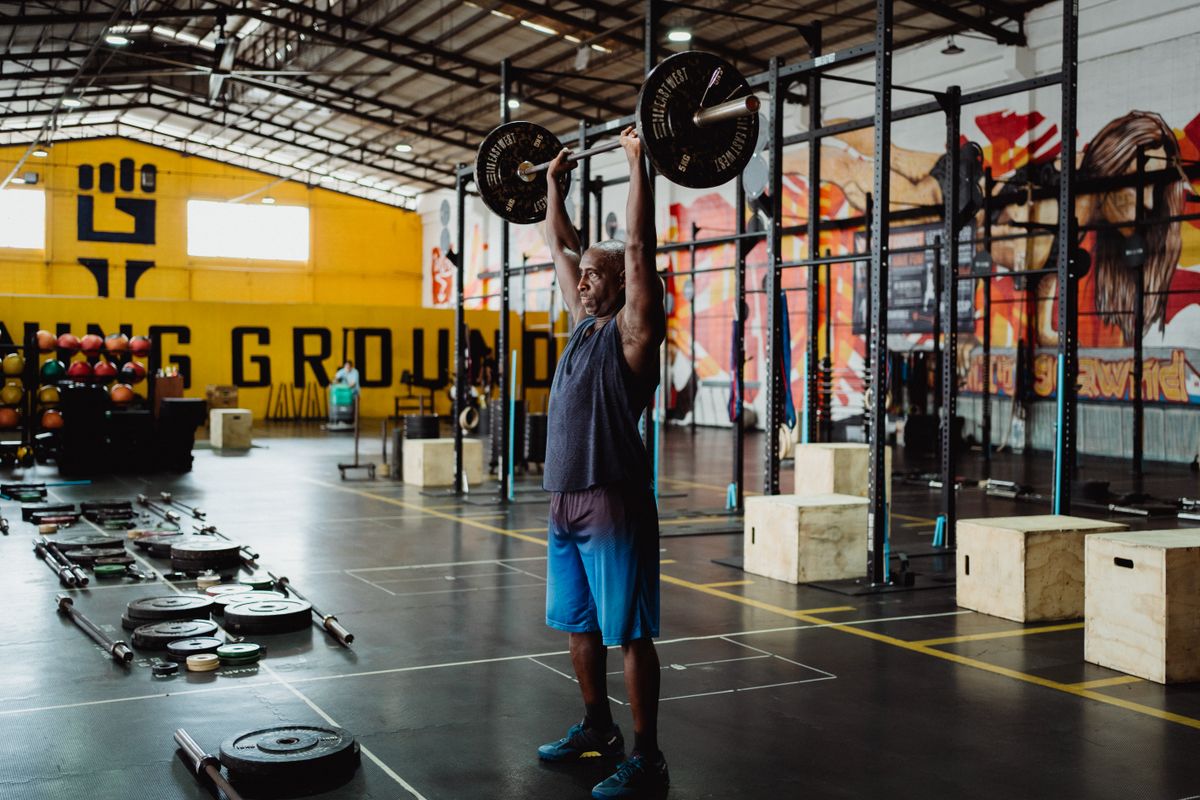
The overhead press is the most demanding upper body movement. It requires core stability, shoulder strength, and technique. Men who can press heavy overhead have shoulders that work correctly and cores that are genuinely strong—not just tight abs.
How to Overhead Press with Perfect Form
The Setup: Stand with feet hip-width apart. Hold the bar at shoulder height, elbows slightly in front of the bar (not behind it). Brace your core as if preparing for a punch to the stomach. Your whole body should be rigid—this is not an arm movement, it's a total-body movement.
The Press: Drive the bar overhead in a vertical line. Your head should move slightly backward as the bar passes your face (to clear it), then you'll position yourself under the bar at the top. Fully extend your arms at the top, with the bar directly overhead.
The Descent: Control the weight as it comes down. Lower it to shoulder height under control, taking 2-3 seconds.
Critical Points for 35+: Many guys lack the shoulder mobility to press safely. If you feel pain in your shoulder during the press, you likely have mobility restrictions or form breakdown. Before adding weight, spend 3-5 minutes doing shoulder mobility work: dead bugs, band pull-aparts, and shoulder dislocations with a band. If shoulder pain persists, consider a shoulder support brace while you build mobility. Your core stability is also critical—if you lean backward excessively, your lower back takes excessive stress. Maintain an upright posture throughout.
Sets, Reps, and Progression
Beginner Program: 3 sets of 5-6 reps, 2 minutes rest. Use a weight you can press all reps with complete control.
Intermediate Program: 3-4 sets of 3-5 reps once per week, 2-3 minutes rest. This is a low-rep, high-tension movement. Recovery is essential, so once weekly is often better than twice weekly, especially if you're benching twice per week.
The Barbell Row: Posterior Chain Power and Posture
What It Works
Primary muscles: Lats, middle back, rear shoulders. Secondary: Biceps, erector spinae, core.
The barbell row is the pressing movement's opposite—it pulls heavy weight toward you. It builds back thickness, posterior shoulder strength (which balances pressing volume), and is essential for maintaining good posture, especially if you spend hours at a desk.
How to Row with Perfect Form
The Setup: Stand facing the bar with feet hip-width apart. Grip the bar slightly wider than shoulder-width. Hinge at the hips so your torso is roughly 45 degrees to the ground (not perfectly horizontal, not upright). Your back should be neutral, your core engaged, and the bar should hang at arm's length with a slight bend in the knees.
The Pull: Pull the bar toward your lower chest/upper abdomen. Think about driving your elbows back and slightly down. The bar should travel in a straight line; avoid allowing it to swing away from your body. At the top of the movement, your shoulder blades should be pulled back slightly (retracted).
The Descent: Extend your arms under control, returning the bar to the start position with a slight pause before the next rep.
Critical Points for 35+: The biggest mistake men make on rows is using their arms instead of their back. You should feel the work in your lats and back, not primarily in your biceps. If you're bicep-curling the weight up, reduce weight and focus on driving elbows back. Also, avoid rounding your back—maintain a neutral spine throughout. If you do start to round, reduce weight immediately. Many men also forget to row consistently because it's "less impressive" than deadlifts, but rowing is absolutely essential for shoulder health and building a complete physique.
Sets, Reps, and Progression
Beginner Program: 3-4 sets of 6-8 reps, 2 minutes rest. Use a controlled tempo, pausing briefly at the top of each rep.
Intermediate Program: 3-4 sets of 5-6 reps heavy weight OR 4 sets of 8-10 reps moderate weight, 2 minutes rest. Row 2x per week (once heavy, once moderate) to balance your bench pressing volume and maintain shoulder health.
Warm-Up Protocol for All Compound Movements
Proper warm-up is non-negotiable. Your tissues are stiffer after 35, and cold muscles are injury-prone. Here's the protocol:
Step 1: General Warm-Up (3-5 minutes) — Light cardio: rowing machine, bike, or jumping jacks. Get your heart rate up slightly and blood flowing.
Step 2: Dynamic Mobility (3-5 minutes) — Movements that prep your working joints: leg swings, arm circles, band pull-aparts, glute activation, and whatever mobility your weak points need.
Step 3: Movement-Specific Warm-Up (5-10 minutes) — Start with just the bar for 5 reps. Then progressively add weight in small jumps: 5 reps at 40% of your work weight, 3 reps at 60%, 2 reps at 80%, then one final prep set at 90% for 1 rep. This wakes up your nervous system and preps your joints for heavy weight.
Never skip the warm-up. It takes 10 minutes and prevents months of injury recovery.
Progressive Overload: How to Build Strength Over Time
Progressive overload means gradually increasing the demands on your muscles. Without it, you plateau. Here are the methods:
1. Add Weight — The simplest method. Add 5 lbs per side to lower body lifts, 2.5 lbs per side to upper body lifts when you complete all prescribed reps with good form. This weekly progression adds up: in 12 weeks, you'll be 30 lbs heavier on lower body lifts.
2. Add Reps — If you're doing 5 sets of 5 and week one you hit 5x5, but week two you hit 5x6 or 5x7, keep the weight the same and add the weight the following week once you hit all sets for all reps.
3. Reduce Rest Periods — If you hit all your reps with 2 minutes rest, try 90 seconds the following week. This increases metabolic stress and builds muscle.
4. Increase Volume — Add an extra set. Move from 3 sets to 4 sets of the same weight and reps. After 2 weeks, add more weight.
Key Point: Progress slowly and consistently. A 5 lb increase per week on a lower body lift is aggressive—if you miss reps, reduce weight and rebuild. Ego lifting leads to injury.
Get Your Free 12-Week Workout Program
Designed specifically for men over 35 who want to build muscle and lose fat safely.
No spam. Unsubscribe anytime.
Equipment to Maximize Your Lifts
You don't need much to master these five movements. A barbell, dumbbells, and a bench is all you need. Here's what's worth investing in:
CAP Barbell 300 lb Weight Set — If you're setting up a home gym, this complete package gives you a barbell, collars, and plates to get started on all five movements. It's the foundation.
Bowflex SelectTech 552 Dumbbells — Adjustable dumbbells are expensive but save space and allow smooth progression in small 2.5 lb increments. Worth it if you have limited space.
Lifting Belt — A 4-inch leather belt (not a neoprene waist trainer) increases intra-abdominal pressure on heavy squats and deadlifts, allowing you to lift heavier safely. Use it only on your heaviest sets (not every set).
Knee Sleeves — Neoprene sleeves worn around the knee provide compression and warmth, reducing pain during heavy squats, especially if you have mild arthritis. They're inexpensive and provide noticeable relief.
Your 12-Week Strength Foundation Program
Here's a simple program to master these five movements over 12 weeks:
Day 1: Lower Body (Squat Focused)
- Squat: 4 sets of 5 reps, 3 min rest
- Deadlift: 3 sets of 3 reps, 3 min rest
- Leg Press (if available): 3 sets of 8-10 reps, 2 min rest
Day 2: Upper Body (Bench Focused)
- Bench Press: 4 sets of 5 reps, 3 min rest
- Barbell Row: 4 sets of 5 reps, 3 min rest
- Overhead Press: 3 sets of 5 reps, 2 min rest
Day 3: Accessory (Optional)
- Weighted Dips: 3 sets of 6-8 reps
- Weighted Pull-Ups: 3 sets of 5-8 reps
- Face Pulls: 3 sets of 12-15 reps
- Ab Work: 3 sets of 10 reps
Run this for 12 weeks, adding weight each week on your working sets. After 12 weeks, reassess and build a new program based on your progress.
Final Thoughts: Strength Is a Skill
Compound lifts are skills. You wouldn't expect to play guitar well after one lesson, and you shouldn't expect to squat heavy with perfect form after one session. Spend the first 2-3 weeks of your program nailing movement quality with light weights. Your ego might take a hit, but your joints—and your long-term results—will thank you.
Master these five movements, train with intention, and you'll build the kind of strength that makes everyday life easier: picking up your kids, moving furniture, standing longer without fatigue. That's functional strength, and it's built on the foundation of compound lifts.
Start light. Progress slowly. Never sacrifice form for weight. Do that, and you'll be stronger at 45 than you were at 35.
Get Your Free 12-Week Workout Program
Download our complete beginner program, exercise video library, and nutrition guide — designed for men over 35.
Get Free Access